 Софийска вода
Urban development in Sofia can be improved by an active advisory committee of all parties involved in the process
The idea was born during a meeting between the WSS operator in Sofia, the Construction Chamber, the Municipality of Sofia and the Regional Directorate for National Construction Supervision
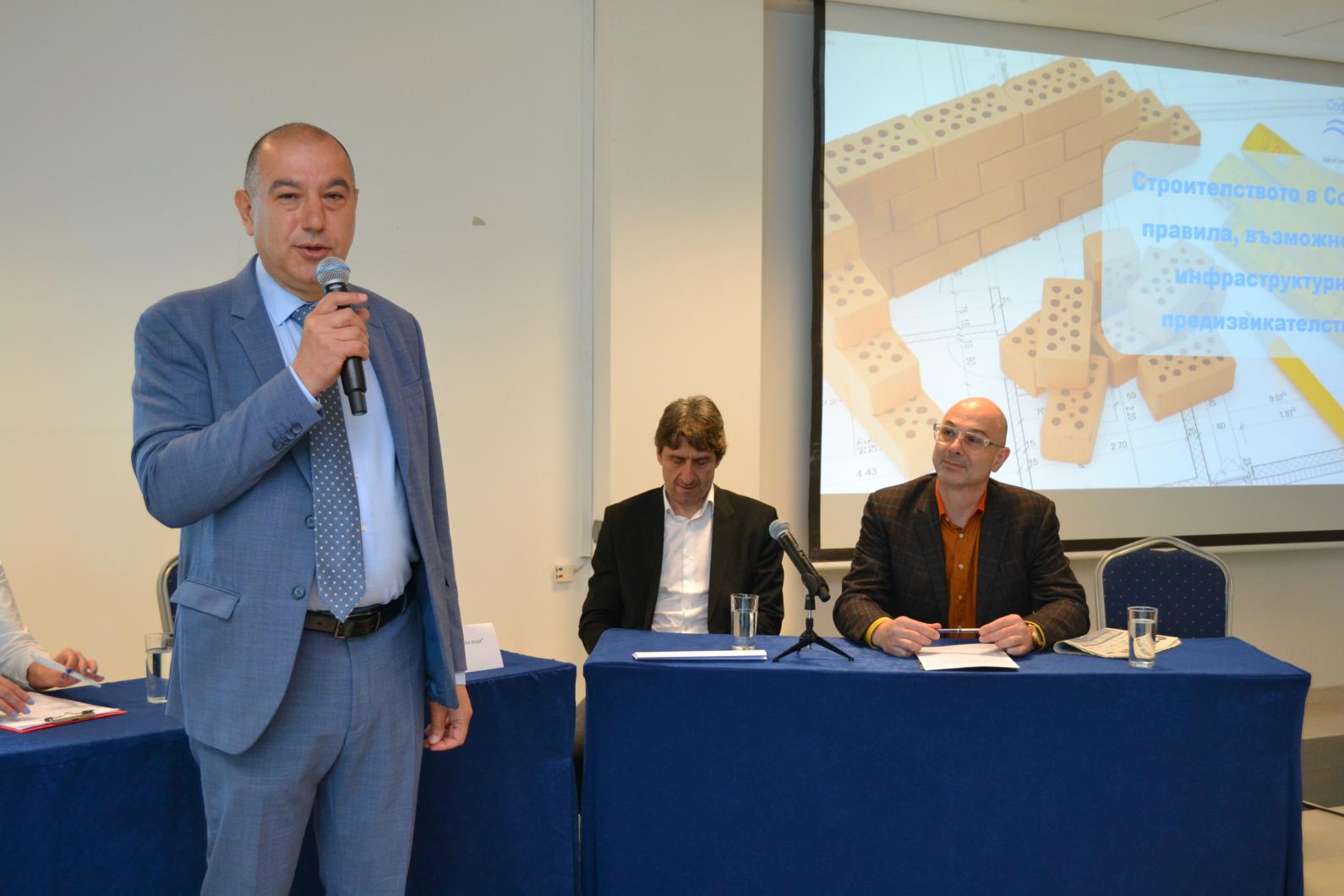
Improvement of the communication between the parties in the construction process, more efficient provision and channelling of funds for the construction of infrastructure, an integrated approach in the area of urban planning and continuous dialogue between all parties involved in the urban development process – these measures were agreed on by the participants in the working meeting “Construction in Sofia – Rules, Opportunities, Infrastructure Challenges”. The representatives of Sofiyska Voda were Vasil Trenev, Executive Director, and Veselin Dimitrov, Technical Director of the water company, and the other participants in the discussion were Eng. Lyubomir Kachamakov, Chairman of the Managing Board of the Bulgarian Construction Chamber, Eng. Blagoy Kozarev, Deputy Chairman of the Managing Board of the Bulgarian Construction Chamber and Chairman of the Regional Office of the Bulgarian Construction Chamber in Sofia, Architect Boyan Nedev, acting Chief Architect at the Municipality of Sofia, Architect Zdravko Zdravkov, head of the Regional Directorate for National Construction Supervision, and Georgi Shopov, Chairman of the Managing Board of
the National Association of Construction Entrepreneurs. At the start of the event, Eng.
Lyubomir Kachamakov welcomed the initiative for such a discussion format. The focus of the statements of the representatives of the stakeholders was how the process of the capital infrastructure development could be better organized within the existing rules, procedures and legislation. Vasil Trenev, the symbolic host, summarized the problem that led to the meeting: "Water is supplied to the distribution network in Sofia. But when that water reaches a small street,
where 10 houses have been provided for under the respective urban planning or conceptual designs, and, all of a sudden, 10 residential buildings emerge there, this is already a problem. We at Sofiyska Voda believe that there is always a solution, but I would like to see, in particular, the general awareness that not only our company has commitment to this issue but all stakeholders involved in the process – property developers, the Municipality of Sofia, architects, designers, we as a utility company, and even the citizens who are interested in buying a home in this area and expect to be provided a quality service.”
A more specific challenge was also discussed – when there is no planned infrastructure, but there is interest in construction, as well as the cases where the already planned infrastructure was not fully built. Veselin Dimitrov focused on that: “For example, there are reservoirs planned and included in the Master Plan, but they have not been built. When there are such cases and an investment interest has emerged in these areas, the designers start seeking a solution on how to reconfigure the infrastructure in order to handle additional water volumes and supply water to a new property. This, however, puts increasing pressure on the existing infrastructure.”
In order to avoid such overloading of the system, a working mechanism should be contemplated for coordination between the Municipality of Sofia and Sofiyska Voda, commented Boyan Nedev, acting Chief Architect of the Municipality of Sofia. “A lot of resources must be invested not only in the construction, but also in the design of this infrastructure. So, we are facing the question of optimization in terms of conceptual designs, how to develop them faster, within what scopes, which areas to develop based on the investment interests of the business, and how to ensure the funding, the site layouts, and the realization after that.” Boyan Nedev also emphasized the need for balance and fairness in
the allocation of the investments among all city residents, who pay taxes. According to Zdravko Zdravkov, head of the Regional Directorate for National Construction Supervision and former chief architect of the capital, the proper planning of the construction and the financing for the urban infrastructure are above all a subject of management policy:
“The first problem is financial – it cannot be resolved for the entire city of Sofia and this should be clear. The subject of the management policy is to determine zones of active influence, where infrastructure development would be guaranteed, and sewers, water mains and resources for expropriation and construction of the chief collectors, respectively, secured. The second problem is related to the fact that the fees for construction permits were not linked to the so-called “bank”, where funds had to be received for public works and improvements of the territory. In case of proper planning, there should be a next step – funds for the capital program for designated territories”.
The chairman of the Managing Board of the National Association of Construction Entrepreneurs Georgi Shopov shared his views in this regard: “We have the specialists and the will, but we do not have the money. In the past year, the construction sector has paid state taxes and fees amounting to 7 billion BGN. According to our calculations, if even 7% of that money were spent on infrastructure development for the area, the new neighborhoods would be green gardens with street lights, sidewalks and a perfect sewer network.” Georgi Shopov argued that those amounts were not being returned to this sector, which was unfair to the citizens.
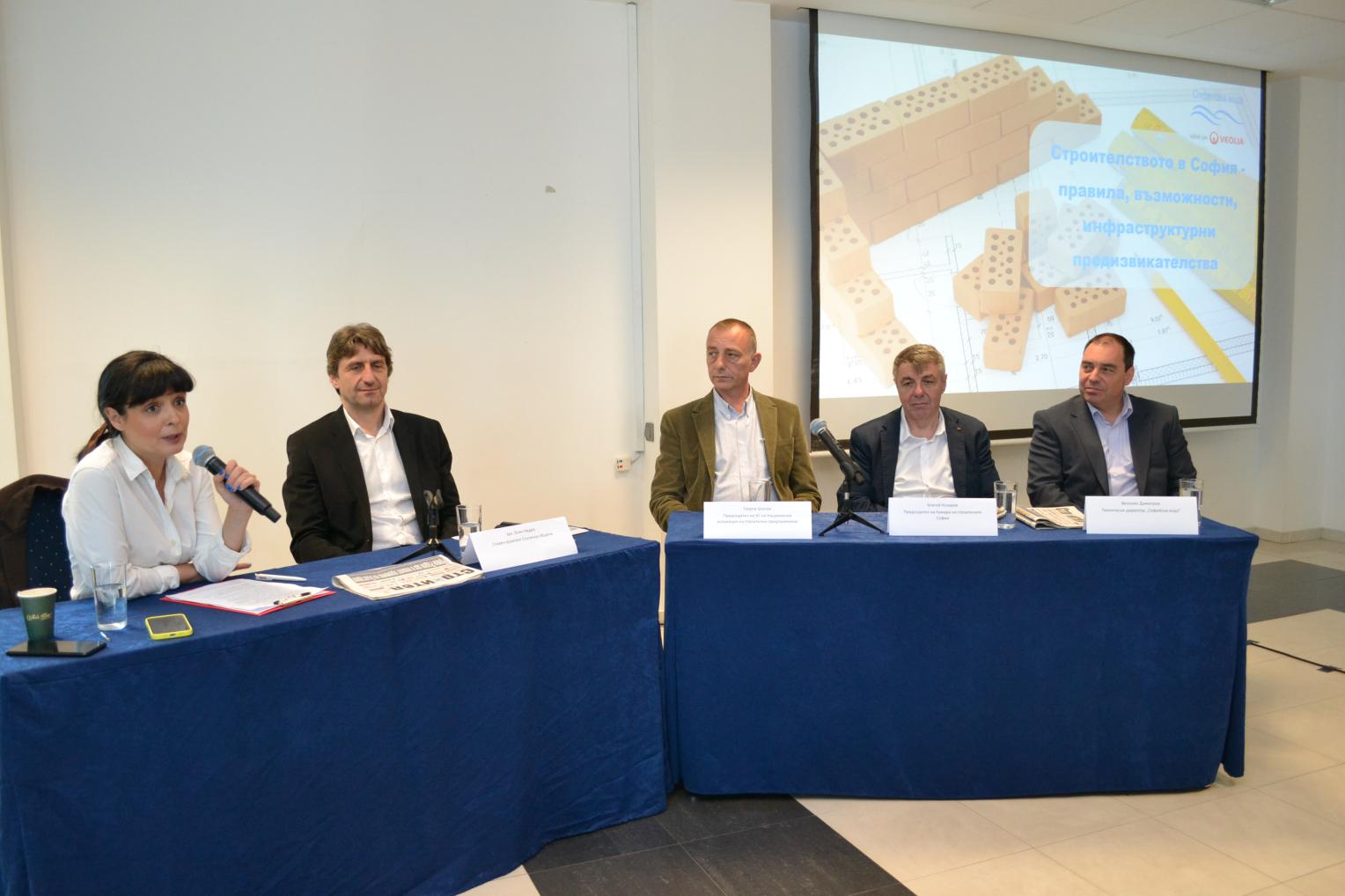
Eng. Blagoy Kozarev, Deputy Chairman of the Managing Board of the Bulgarian Construction Chamber, joined the dialogue and summarized that the solution was a “radical change in the approach to implementing the investment intentions. Because if we do not reverse the entire process and do not view it from a more global perspective, if we continue working piecemeal, we will not get too far”.
The participants in the meeting unanimously agreed to create a joint advisory body to periodically discuss the specific challenges facing the capital's integrated development and jointly seek lasting, working solutions.
All parties would greatly benefit from the digitalization and the use of AI technologies for evaluation, quality and synchronization of the plans and their implementation in urban construction.